Soldering Saturdays: How a Generation of Gamers Is Rebuilding Their Childhoods One Circuit Board at a Time
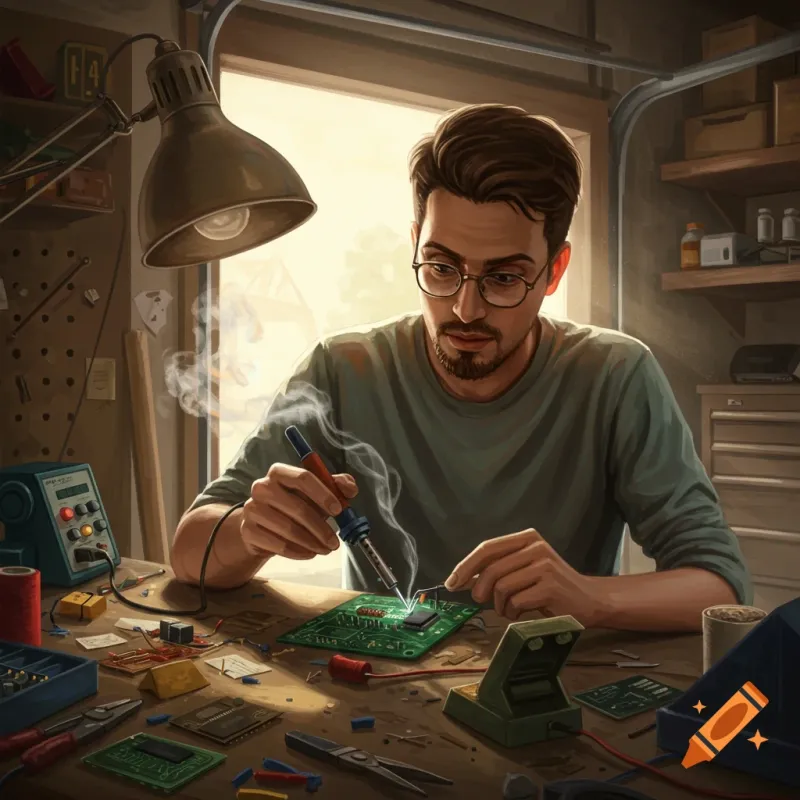
Photo: person soldering Game Boy circuit board electronics workshop, via media.craiyon.com
There's a specific kind of satisfaction that comes from firing up a Game Boy you've spent three hours rebuilding from scratch. The backlit screen glows crisp and bright — nothing like that original pea-green squint-fest you remember from the back seat of your parents' minivan — and for a second, the gap between 1994 and 2024 collapses completely. You're playing Tetris again, but it looks better than you ever imagined it could.
This is the Game Boy modding scene, and it has quietly grown into one of the most passionate corners of retro gaming culture in the US. What started as a niche hobby for electronics tinkerers has expanded into a full-blown community of thousands — complete with dedicated subreddits, YouTube tutorial channels racking up millions of views, and a thriving parts market that didn't even exist five years ago.
What Exactly Are People Doing to These Things?
At its most basic level, Game Boy modding means opening up an original Nintendo handheld — whether that's the classic brick-shaped DMG from 1989, the Pocket, the Color, or the Advance — and improving it in ways Nintendo never intended.
The most popular upgrade by far is the IPS screen swap. The original Game Boy's reflective LCD was, to put it charitably, a product of its time. Playing without a light source nearby meant squinting at moving shadows. Modern IPS replacement screens — sourced primarily from specialty retailers like Retro Game Repair Shop or through AliExpress suppliers — drop right into the original shell with a little trimming and some careful soldering. The result is a backlit, vibrant display that makes classic games genuinely pop.
Beyond screens, modders are also replacing shells with custom-colored or translucent alternatives, swapping out worn button membranes, installing rechargeable lithium-ion battery solutions, and even overclocking the original processors to run games at smoother speeds. The more advanced tinkerers are doing full motherboard "bivert" mods and installing custom firmware that lets a single device run games from multiple platforms.
It sounds technical — because it is. But that's kind of the point.
The Skills Pipeline Nobody Expected
Ask anyone in the community how they got started, and you'll hear a version of the same story: they watched a YouTube video, figured they could probably do it, bought a cheap donor unit off eBay, and destroyed it completely on the first attempt. Then they tried again.
"My first DMG looked like I'd attacked it with a spoon," laughs Marcus T., a 34-year-old IT administrator from Columbus, Ohio, who now runs a small modding side business out of his garage. "The shell was cracked, I bridged three solder joints, and the screen had a dead line down the middle. I loved every second of troubleshooting it."
That learning curve is part of the appeal. A generation that grew up consuming technology as a finished product is now demanding to understand how it actually works. The Game Boy, with its relatively simple circuitry and abundance of cheap donor units, serves as an ideal entry point into electronics repair and modification. Community guides on sites like the Game Boy subreddit and Retro Game Repair Shop's tutorial library walk beginners through every step with the kind of patience that formal education rarely offers.
Some modders have parlayed the skills they developed over a Game Boy workbench into actual careers in electronics repair, PCB design, and hardware engineering. The handheld becomes a classroom — one you can play Pokémon on when class is over.
The Economics of Nostalgia
This hobby isn't cheap, and it isn't trying to pretend otherwise. A complete, high-quality IPS mod on a Game Boy DMG can run you anywhere from $80 to $150 in parts alone, not counting the cost of the donor console, tools, or the hours of your time. A fully modded unit commissioned from a skilled builder can fetch $200 to $400 on platforms like Etsy or eBay — sometimes more for particularly clean work or rare custom shells.
For context, you can pick up an unmodified Game Boy DMG for anywhere between $20 and $60 depending on condition. The markup reflects real labor and expertise, but it's also a statement about what people are willing to pay to hold a piece of their childhood that actually works the way they wished it had back then.
The parts supply chain has grown up alongside the demand. Funnyplaying, Hispeedido, and Cloud Game Store are among the suppliers that have built entire businesses around producing high-quality Game Boy replacement components. It's a cottage industry that didn't exist a decade ago, now generating real revenue on the back of hardware that Nintendo officially discontinued years ago.
Why This, Why Now?
The timing of the modding renaissance isn't accidental. The oldest millennials are well into their thirties, with disposable income they didn't have as kids and a growing sense that the technology of their youth is worth preserving — and improving. There's also something psychologically compelling about the act of repair itself in an era defined by planned obsolescence and devices that punish curiosity with voided warranties.
Modding a Game Boy is the opposite of that. It rewards curiosity. It's tactile, it's personal, and the finished product is genuinely yours in a way that buying a new Switch just isn't. You know every solder joint. You chose the shell color. You picked the screen brightness level.
There's also a communal dimension that social media has amplified. Sharing a finished build on Reddit or Instagram connects you instantly to thousands of people who understand exactly what went into it — and who will ask the right questions about which shell supplier you used.
The Pixel-Perfect Payoff
What the Game Boy modding community ultimately represents is something RetroPixel readers will recognize immediately: the refusal to let great technology just fade away. These handhelds were built to last — the hardware is legendarily durable — and a generation of tinkerers has decided that with a little skill and a lot of patience, there's no reason they can't last another thirty years.
The Game Boy wasn't perfect when it launched in 1989. But in 2024, with the right modifications, it might finally be.