Rewind Required: The Video Store Clerks Who Watched Streaming Kill the Rental Era
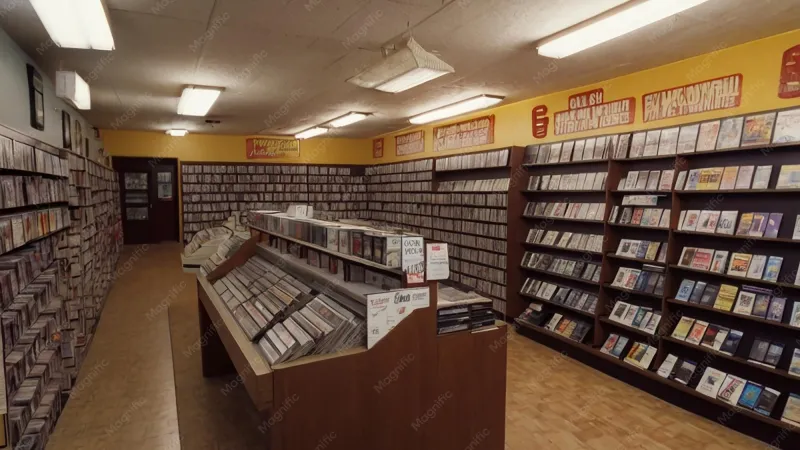
Photo: vintage video rental store VHS tapes shelves clerk counter 1990s, via img.freepik.com
There's a particular kind of institutional knowledge that disappears when a whole industry collapses. Not the kind you find in business school case studies or tech journalism post-mortems—but the ground-level, fluorescent-lit, Friday-night-rush kind. The kind that lived behind the counter at your local video rental store.
We tracked down a handful of former clerks from stores across the country—from regional chains to the occasional surviving independent—and asked them a simple question: What do you actually remember? What came back was a surprisingly rich oral archive of an era that digital culture swallowed whole.
The Recommendation Was the Product
Before algorithms, there were people. Real ones, with opinions.
"Half the job was just knowing movies," says Marcus, who worked at a Hollywood Video in suburban Ohio from 2001 to 2008. "People would come in with basically nothing—like, 'I liked The Matrix, what else?'—and you had maybe thirty seconds to read them and give them something good. If you nailed it, they'd come back and ask for you specifically."
That culture of human curation is something almost every former clerk mentions unprompted. It wasn't just a job perk—it was a genuine skill set, and for many of them, the most meaningful part of the work. Janelle, who spent six years at an independent rental shop in Portland, Oregon, describes it as "basically being a librarian who was also allowed to have strong opinions."
"I turned so many people onto foreign films," she says. "You'd have a guy who only ever rented action movies, and you'd just slip Crouching Tiger into the pile and say 'trust me.' That interaction doesn't exist anymore. Nobody's getting surprised by a movie because a stranger at a streaming service thought they should see it."
The Late Fee Was a Relationship
Ask any former clerk about late fees and you'll get a laugh before you get an answer. The fees were universally hated—by customers, and honestly, by most of the clerks too. But they also created a strange recurring intimacy.
"You'd see the same people every week," says Derek, who worked a Blockbuster in Atlanta from 1998 to 2005. "And yeah, sometimes they owed money, and that was awkward. But it also meant you knew them. You knew what they liked, you knew their kids' names, you knew if they were going through a rough patch because they stopped coming in for a while."
Netflix's decision to eliminate late fees in 2005—and Blockbuster's panicked attempt to match them—comes up in nearly every conversation as a turning point. Not just financially, but culturally.
"When the late fees went away, something shifted," says Marcus. "The urgency was gone. People stopped rushing back. And then slowly, they stopped coming back at all."
The Night They Knew It Was Over
Every clerk has a version of this story. A specific moment, or a slow-building dread, when the math stopped adding up.
For Janelle, it was a Tuesday in 2009. "We had a new release wall that was maybe a third full. Two years earlier it would've been packed. I remember thinking, we used to have a waiting list for this stuff. Now I'm just standing here."
Derek's moment came earlier—around 2007, when the store he worked at started stocking more candy and snacks near the register. "When a video store starts trying to be a convenience store, you know it's scared," he says flatly. "That was the tell."
For Sandra, a former clerk at a Hastings Entertainment in New Mexico, the end came in the form of a customer question that she still thinks about. "A teenage girl came in and asked me, totally genuinely, why anyone would come here instead of just watching it online. She wasn't being mean. She just actually didn't understand. And I realized I was struggling to explain it."
What Streaming Didn't Inherit
It's easy to frame the death of the video rental store as pure progress—cheaper access, infinite selection, no driving required. And in a lot of ways, it was. But the clerks who lived through the transition tend to identify real losses alongside the obvious gains.
The physicality of the experience comes up constantly. The weight of a VHS case. The smell of the store. The cover art that could sell you a movie before you read a single word. "Streaming thumbnails are so flat," says Marcus. "Old VHS boxes had art. They were designed to make you pick them up."
There's also the question of what happens to discovery when the recommendation engine replaces the recommendation human. Algorithms are optimized for retention, not revelation. They give you more of what you already like rather than nudging you toward something that might genuinely change your taste.
"I introduced people to movies that became their favorites," says Janelle. "Movies they never would've found on their own. I don't know what the streaming equivalent of that is. Getting served an ad?"
The Archive We Didn't Save
Some of what those stores contained is simply gone. Regional chains carried regional tastes—local documentaries, obscure regional productions, titles that never made it to any digital platform. When the stores closed, a lot of that inventory was liquidated, trashed, or lost.
"We had stuff in our back room that I've never seen mentioned anywhere online," says Sandra. "Local stuff, weird stuff, stuff that somebody clearly loved enough to put on tape. I don't know where any of it ended up."
That's the part of the video rental era that's hardest to preserve: not just the movies, but the context around them. The handwritten staff picks cards. The seasonal display themes. The particular logic of how a specific store organized its shelves. That institutional knowledge—the human layer of the whole enterprise—evaporated when the lights went out.
What these clerks carry is something no streaming service can restore: the memory of a time when watching a movie started with a conversation, ended with a deadline, and meant something different because it cost you a trip across town and a little bit of your Friday night.