Blink and You'll Miss It: The Strange, Meditative Power of the Flashing Text Cursor
It's just a blinking line. A rectangle of light that pulses on and off, over and over, going absolutely nowhere. And yet, for anyone who grew up staring at a terminal screen or hammering away on an early word processor, that tiny flash carries an almost inexplicable emotional weight — part invitation, part patience test, part meditation.
The blinking text cursor is one of the most quietly iconic elements in the entire history of computing. It never asked for your attention. It never had a marketing campaign or a design manifesto behind it. It just showed up, pulsed steadily, and somehow burned itself into the collective memory of every person who ever sat down to type something into a machine.
So how did this happen? How did a flickering sliver of phosphor light become one of the most psychologically loaded symbols in digital culture?
Where the Blink Came From
The blinking cursor didn't emerge from some grand design philosophy. Like so many beloved elements of early computing, it was born out of pure technical necessity.
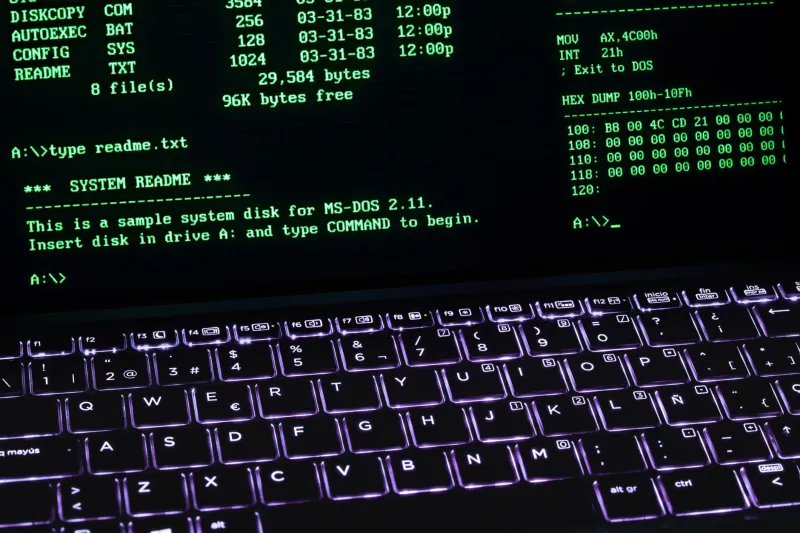
In the days of cathode ray tube terminals — think the late 1960s and through the 1970s — engineers needed a way to show users where text would appear next. The screen was a dark, mostly featureless expanse. Without some kind of marker, you were essentially flying blind. Early solutions included underline indicators and solid block cursors, but the blinking part came as an almost accidental discovery: a cursor that alternated between visible and invisible was far easier to spot against the low-contrast glow of early monitors than a static one.
The blink rate itself — typically somewhere between once and three times per second — wasn't chosen for any deep ergonomic reason. Engineers landed on that rhythm because it was fast enough to catch the eye without being so rapid it caused visual noise. It was, essentially, a guess that happened to work.
By the time personal computers started showing up in American homes in the late 1970s and early 1980s, the blinking cursor was already a standard. The Apple II had it. The TRS-80 had it. The Commodore 64 had it. Every kid who booted up a machine for the first time was greeted by that quiet, patient pulse — as if the computer itself was sitting there, breathing slowly, waiting to see what you'd do next.
The Psychology of the Pulse
Here's where things get genuinely interesting. The blinking cursor isn't just a navigational tool. It's a psychological signal, and researchers who study human-computer interaction have spent real time trying to understand exactly what it does to our brains.
The core function is what interaction designers call a readiness cue — a signal that the system is idle and awaiting input. But the blink does something more subtle than just saying "I'm ready." Its rhythmic nature creates a kind of low-level cognitive loop. Your eye catches the flash. Your brain registers it as a prompt. You haven't typed yet, so the cursor blinks again. And again. There's a gentle, almost conversational pressure in that repetition — not urgency, exactly, but presence.
Some psychologists have compared the effect to a tapping finger or a softly ticking clock. The cursor isn't demanding anything from you, but it's absolutely there, reminding you that time is passing and the page is still empty. For writers especially, the blinking cursor developed a near-mythological status as a symbol of creative anxiety — that blank screen with its patient, relentless pulse became shorthand for writer's block itself.
And yet, paradoxically, many people also describe the cursor's blink as calming. In the context of early computing, before notifications and pop-ups and infinite scroll, that steady rhythm was one of the only things happening on screen. It was the machine's heartbeat. Focusing on it felt almost meditative.
Redesigning a Classic
Fast forward to today, and the blinking cursor is everywhere and nowhere at once. Every smartphone keyboard has one. Every text field in every web browser has one. But in the context of modern interfaces — surrounded by animations, gradients, video backgrounds, and notification badges — the cursor blink barely registers.
Unless, of course, someone decides to make it the point.
A growing number of designers and artists working in retro-adjacent spaces are deliberately pulling the blinking cursor back into focus. You'll find it in indie game interfaces that evoke the terminal aesthetic of early adventure games. You'll see it in lo-fi music visualizers that use command-line-style text as a backdrop. Some web designers building personal portfolios have started using oversized, slowly blinking cursors as the central visual element of their landing pages — a deliberate throwback that reads as both nostalgic and weirdly sophisticated.
There's also a quieter movement happening in productivity software. Apps like iA Writer and a handful of distraction-free writing tools have made a point of letting users customize their cursor blink rate, or even choose a vintage block cursor over the modern thin beam. The argument is partly aesthetic, but it's also philosophical: slowing down, returning to the visual vocabulary of early computing, can help recreate the focused mental state that older interfaces accidentally encouraged.
The Cursor as Cultural Artifact
What's striking about the blinking cursor's staying power is how completely it transcends its original function. Ask someone who spent their formative years in front of a green-screen terminal or an early DOS machine what that blink means to them, and you'll hear answers that have nothing to do with text entry. You'll hear about late nights writing bad poetry on a hand-me-down PC. About the specific silence of a house at 2 a.m. with nothing but that pulse and the hum of a CRT for company. About learning to type, learning to code, learning to think in a new way because a machine was sitting there, blinking, patient as anything, waiting for you to begin.
That's a lot of meaning to pack into a rectangle of light that's roughly four pixels wide.
But that's kind of the whole story of early digital culture, isn't it? The tools were simple. The constraints were real. And somehow, inside those constraints, a visual language emerged that people are still emotionally attached to decades later. The blinking cursor isn't just a piece of interface design history — it's a tiny, rhythmic monument to the moment humans and machines first started figuring each other out.
And somewhere on your screen right now, in some text field you've half-forgotten about, there's probably one blinking away. Patient. Present. Waiting.
Just like it always has.